Showing posts with label intervals. Show all posts

Wednesday, September 30, 2015

Stationary Trainers:Yes, you are that crazy!

In this blog I've talked a lot about endurance rides, bouncing back from extended time off the bike, and my personal accomplishments.  I've touched on the importance of my stationary trainer in several different entries, but I have not really done an entry dedicated completely to the dreaded stationary trainer.  With Fall here, and cooler weather just around the corner, it is time to start thinking about your riding options.  If you happen to live in NC, we have now been a rainy mess for a solid week, with no real break in sight.  Since I am a self proclaimed weather weenie, that means that I have not been riding outside for that whole week.  However, I have been riding...just on a stationary trainer in my home office.  I have also been noticing that many folks have been starting to think about pulling theirs out as well, or going to buy one.  I've fielded questions and concerns about stationary trainers in bits and pieces, but realize that most of the basic concerns are pretty much the same.  I figure that I might as well put together a dedicated entry that addresses some of the most common questions about riding your bike indoors.


The first question that everyone is thinking, but nobody really asks is..."Why in the hell would you subject yourself to an endless barrage of pedal strokes inside, while not actually going anywhere?"  OK, that is a valid question, and one that I still ask myself to this day.  Yes, it sucks, especially when you are doing an intensive workout.  There is no scenery to watch, usually very little company to be had, and you sweat....a lot!  In general, it is not fun.  That is why so many riders decide to dress up in cold weather gear and go outside to continue riding their road bikes.  A good share also move into cyclocross and mountain bike disciplines.  This latter option may very well be the best one as it will confuse your muscles and force you to ride in different ways than you have for the warmer months.  For me though, I have little to no interest in mountain bike trails, and cyclocross holds an equal place for me.  I am a true roadie.  For me, nothing compares to the speed and grace of a road bike as it glides across the asphalt, or grinds up an incline to a distant summit.  This is where my passion is, and what I enjoy about cycling.

For those like me, you have two options....well three, I guess.  The first is to layer up and head out into the cold.  In some areas of the globe, this isn't that bad as winter temperatures don't dip below 50.  In other areas, the eight feet of snow makes winter cycling difficult at best.  Here in NC, we fall somewhere in the middle.  Our days are are typically in the 30's during the winter, and there are times we see them climb into the 50's.  I can ride in that, but freezing isn't that much fun for me.  The other option is to mount a bike up to an indoor trainer, or rollers, which will allow you to pedal in the warmth of your home, basement, shed, whatever.  There are advantages and disadvantages to this plan as we will get into shortly.  The third option, is to tuck your bike in for the winter, and do another activity, like running (not unless somebody is chasing me).  You could also catch up on all that high quality television you missed while achieving your current level of fitness. Yeah, I didn't think that sounded like a good plan either.

What Will a Stationary Trainer Do For Me?

Lets talk about that indoor cycling option.  What can it do for you?  Well, the
possibilities are endless, but simply put, you can build fitness where there was none, you can maintain your fitness, or you can actually improve it.  It all comes down to how much effort you want to put into your time indoors.  Over the years, I have used an indoor trainer for each of these functions with great success.  I don't, however, recommend doing sprints down the hall.

If you are starting from square one, using an indoor trainer is a great way to get conditioned in order to start out strong when Spring hits.  If you are new to clipless pedals, you can use the trainer to get used to the motions associated with clipping in and out without fear of falling.  Speaking of clipless pedals, you can learn a whole new method of pedaling which is specific to having your feet surgically attached to your cranks.  By pulling up on the pedal in addition to the standard pushing down, you can engage your hamstrings in order to assist, and take the load off of your quads.  You can also engage the glutes more effectively with this type of pedaling.  Essentially, you can learn to pedal in circles rather than in straight lines, or boxes.  To do this on a trainer is simple, and safe.  Start easy, by unclipping on foot and pedaling for 30 seconds at a moderate tension with the remaining foot.  Pay attention to your pedal stroke, you should be able to pedal at a smooth rate all the way around the stroke.  At the end of that 30 seconds, swap feet and repeat.  Do this for about 5 minutes or so total and then pedal easy to recover. Repeat as you deem necessary to train the muscles.  When you master the 30 second repeats, move it up to a minute on each side for a total of 6 minutes.  The more you do it, the better you will get at it.

As you are mastering the pedal stroke, you will be becoming more and more efficient with your pedaling as a whole.  This will help you be able to increase your cadence.  Some might not need to worry about increasing their cadence, but I would suspect that most cyclists start out pedaling way too slow.  By too slow, I mean below 70rpms.  I was guilty of that for a very long time, and I've seen it with many other newbie cyclists...and some seasoned ones as well.  It might feel good to push the big gears and feel the muscles in your legs swell with power.  It won't feel good for long though.  Your muscles are what burns the calories, and create heat.  This means that you aren't going to be able to ride for a long period of time before getting fatigued, and slowing down substantially.  With a higher cadence, you are actually doing the same amount of work, but taxing the muscles only a fraction as much.  Power is just work over time.  By increasing the pedal strokes, you are reducing the work per stroke while achieving the same power.  The faster you pedal, the less fatigued you get over the course of a ride.  Ideally, the average cyclist will want to maintain an average cadence between 85-95 rpms for the course of a "normal" ride.

In addition to getting some of the basics down, an indoor trainer can also be used to maintain your fitness in the "off season."  This might be the most useful function for this piece of equipment.  The time that you can ride outside in the Winter might be limited due to weather and shorter days, so you can easily supplement those rides with a few rides indoors each week.  Depending on what you are able to do outside, you might just need to get on the trainer and spin for a bit to keep the legs fresh, or to recover from an all out effort on the road the day before.  If your outdoor rides are limited to a few per month, you will need to add some higher intensity workouts to your plan indoors.


Don't let the term "high intensity" scare you.  It is just a natural replacement for volume.  Trust me, you don't want to sit on a trainer for 50-60 miles...well, you might, I have, but I can't recommend it.  For those of you who are still sane, the replacement for volume of workouts is the intensity of the workout.  A good rule of thumb for an indoor trainer is that every hour spent on a trainer is equal to approximately 1.5 hours on the road.  That makes complete sense when you think about it.  There is no coasting, no stop signs, no traffic, just no interruptions.  Once you start, you will pedal at your target until it is time to change it up.  That means right off the bat, you are getting more bang for your buck.  Now, lets add in what is known as High Intensity Interval Training.  That will step things up quite a bit.

HIIT is where the love/hate relationship with a trainer is rooted.  Again, you are trying to replace volume of your rides (workouts) with intensity.  When I go out for a road ride, I am typically out for over an hour, up to 6 hours.  I'm not going to dedicate that kind of time to riding indoors, and that is fine. Using intervals, I can hit all my target zones in a shorter amount of time, and get my metabolism racing.  I can also keep my muscles active at a level that will keep me from losing my fitness from the previous season.

So what exactly are intervals?  This is a form of workout that includes segments of intense riding, followed by active recovery periods.  They are repeated throughout the workout.  For example, a simple interval workout would include a warm up phase at the start that is pretty much easy pedaling for 10 minutes or so.  Then you would step into three sets of max efforts that last one minute each, followed by a one minute easy pedal to catch your breath.  Then you move into three more sets of threshold output (anaerobic level) for eight minutes each followed by a four minute recovery period between each set.  The end of the workout is a cool down segment to bring your heart rate back to normal.  This workout would last an hour, and in that hour, your body has done an incredible amount of work.
A graph of my heart rate for the above interval workout
There are many different types of interval programs out there.  This is only a basic one.  There are ones that simulate hill climbs, work on sprinting, and others that can help train for the fast changes of a criterium race.  Whatever you are wanting to focus on, there are interval programs for you.  If you don't have an hour, there are even shorter ones out there. The simplest is called pyramids.  Essentially, you can do a single repeat of this, or as many as your time allows. You would start out with a warm up, of at least five minutes.  After that warm up, you would do this workout.

3 minutes zone 3 (aerobic)
3 minutes easy spin
2 minutes zone 4 (anaerobic/threshold)
2 minutes easy spin
1 minute zone 5 (max effort)
1 minute easy spin
2 minutes zone 4 (anaerobic/threshold)
2 minutes easy spin
3 minutes zone 3 (aerobic)
3 minutes easy spin
repeat or cool down for 5 minutes

This interval set could be done in a lunch hour at the office, or at home after work.  It doesn't have to take long, but you can go until you have had enough, and make it as long as you would like.  It is very effective, and simple to execute.


The last scenario I want to talk about is improving your fitness levels.  Yes, you can grow as a cyclist in the off season if you so wish to do so. Whether you are at the top of your game, or have lost a lot of your previous fitness due to a crash, or just time away from riding, you can actually increase your base fitness on a trainer.  This is exactly where I fell last winter after 10 months off of the bike.

Using those same HIIT workouts, but at a higher volume, you can improve your fitness from whatever level you started from.  Personally, I was going from a condition that took 10 months away from riding to achieve.  I was overweight and out of shape.  By sticking to a program that had me on the bike between 30 minutes and 2.5 hours at a time for six days a week, I had both the intensity and the volume needed to not only achieve my previous level of fitness, but to exceed it before the next cycling season.  I credit most of my success with following a plan I found through Bicycling Magazine called Fat Frying Intervals.  This is a five week long program that is an adaptation from a nine week program created by James Hererra.  It is too involved to list it here, but I can say it will kick your butt, and bring quick results.  In just a matter of months, I was near to my former performance, and my body was getting back to its riding weight.  I can only imagine what would have happened if I had put this much energy into the trainer sessions at a top level of fitness.  This is where riders come back after the winter stronger and faster than they were before.  Even if you can ride outside in your neck of the woods, it is a great idea to incorporate some HIIT sessions into your weeks for this very reason.

This is also a time when you can work on your riding weaknesses.  Everyone has their niche on a bike.  Some are sprinters, some love the climbs, some go that extra mile, but it is rare to find a cyclist that can do it all well.  Using a trainer, you can pick and choose your interval program (a Google search away) to address your weaknesses.  For instance, I have never been a great climber, and have always felt very uncomfortable standing out of the saddle.  I was able to locate two different hill workouts that incorporated standing intervals, as well as a lot of tempo work.  True, I wasn't actually climbing, but I was stressing my muscles as if I were.  I learned to stand more confidently, as well as put power down for longer periods of time under strain.  Doing these workouts once a week each, for a month really made a difference in my climbing times.  I was actually able to sprint up hills that I had formally had to drop into the little ring to climb up.  That is a huge difference!


What do you need?


Well, you need a bike obviously.  Ideally, you don't want to put a carbon fiber bike on a trainer because it is just a little too rigid for the fibers. But there are times you have to do what you have to do.  I've put thousands of miles on carbon bikes mounted to trainers with no ill effects.  Your experience might be different though.

OK, you have the bike.  You also need a trainer.  There are many different types of trainers available out there.  Some are even computer based and hook up to a laptop.  The basic types are wind, magnetic, and fluid.  They each have their pros and cons.  The wind and magnetic are the cheaper options, but they lack a road feel, and are very noisy.  The fluid ones are much quieter, have a progressive resistance, and feel very close to the road.  The computer based ones are the most expensive and can either be fluid or magnetic based. The program will adjust the resistance in most cases to match the workout.  Of course, for these, you will pay a premium.  They are usually used by pros.  For the average rider, magnetic or fluid will be the way to go.

I am currently using a Cycleops Fluid II stationary trainer, which is a fluid based trainer.  As you can see from the picture above, it has a nice footprint, and attaches to the bike by way of a skewer through the rear hub that mounts to clamps on either side.  This is a very secure way to attach the bike.  There is a flywheel that is then pressed up against the rear wheel which turns the impeller through the viscous fluid.  The faster you pedal, the more resistance it gives, just like pedaling on the road.  This is essentially all you need, but there are quite a few accessories that will make this trainer more functional and dare I say...fun.


Here you see some triangle shaped blocks under the front wheel.  These are riser blocks and come in some different styles. I like the Cycleops versions the best because you can stack them to simulate climbing (engages muscles differently).  Typically, you would just use one of these blocks.  It is designed to get the bike level since the rear wheel is lifted while attached to the trainer.  There are three different degrees of lift you can choose from.  I prefer the biggest lift because it tends to take some of the pressure off of the soft tissue that you are sitting on, as well as reducing the strain on your hands.

The mat under the bike is also a nice bit of equipment, especially for those working out inside the living area of your home.  This mat keeps some of the noise down, but more importantly, it helps to collect the sweat that pours off of you while doing your HIIT workouts.  You will be sweating...A LOT!  If not, you are doing it wrong.  The mat will also help to save your carpet, or hard wood floors from the constant movement of the trainer and riser blocks due to the force you are applying.

Speaking of sweat....if you are like me and find that you are actually raining on the floor after about 20 minutes, you should invest in a sweat shield like this one.  It is also a Cyclops product, but similar ones can be found by other companies and are just as effective.  They are designed to stay out of the way of you working the bike, but don't try to use it while riding outside as it does attach to the handlebars and restricts the movement.  For inside, however, it is nearly perfect.  It will protect the frame from your salty drips, and will keep a large portion of your sweat from getting into the bearings, but you should still wipe the bike down after your rides if you see that your sweat has made it near those sensitive areas.

You will also need a fan.  It is very easy to get overheated while doing intervals.  You don't have the advantage of the breeze drying your wicking clothing off, so you should manufacture your own breeze.  It isn't as effective, but it does help. Keep the fan close and don't skimp on the speed.  It will be chilly to start with, but after about 15 minutes it will feel great.  By the end, you will want to be immersed in ice.

Something else you might be noticing in this picture is the red tire on the rear wheel.  This is not a fashion statement by any stretch.  Actually, it looks a little tacky.  That is a good thing because this tire is not meant for road use, and the color is a readily identifiable warning to that fact.  This is a trainer tire and it is specifically designed for use on a stationary trainer.  It is a much harder compound than a road tire, and there is a tread pattern on it that is designed to dissipate the heat buildup that is caused from the tire rolling on the drum of the trainer.  In many cases, they are also quieter than a road tire would be.  This one is a Vittoria tire, but most tire manufacturers make their own version of a trainer tire.  Pick the one at the price point you can afford.  Since the compound is harder on these tires, they will last a nice long time.  A road tire will be torn to shreds long before it would wear out being used on the road.  This tire will save your expensive road tires for your road rides.
Garmin Edge 500 Computer mounted in front of the bars

Garmin GSC-10 Speed/Cadence Sensor mounted to the chain stay

Cycleops Powercal heart rate monitor mounted to me
I've been doing a lot of talking about measuring cadence and heart rate while on the trainer.  These are the hard training numbers that you need when working on an interval plan. Sure, you can get on the bike and spin for a certain amount of time, and just "wing it," but that really won't cut it if you are serious enough to own a trainer.  You need a way of keeping track of what your body is doing in order to make the most of your time.  Pictured above are some examples of what you should be considering.  I am a fan of the Garmin electronics, but there are other options out there, and many are at a lower price point.  You will need a head unit, the cyclometer.  This will display and record the metrics that you produce.  When on the road, a GPS enabled unit, like the Garmin ones will track distance and speed based on the satellite signal.  When indoors on a trainer, or rollers, this obviously won't work.  You aren't moving, and the computer will see no activity unless you add some sensors in.

At the very minimum, you will need a speed and cadence sensor.  What typically comes bundled with the Garmin units is their GSC-10 all in one unit.  It works off of magnets which are mounted to both the rear wheel (the only one rotating when on a trainer), and the crank arm.  This allows the head unit to see how fast the rear wheel is moving which gives you speed and distance.  It also allows you to see exactly what your cadence (pedal stroke) is at any time.  Garmin has recently come out with a magnetless set that I think works much better overall, and is easier to switch between bikes.  The speed sensor mounts to the rear hub with a rubber strap.  The cadence sensor mounts to the crank arm with another rubber strap.  There is no receiver unit with this and that cleans up the chain stay quite nicely.  Either way, you will have the same information going to the head unit.  Any sensor will work as long as they are Ant+ compatible.  Other units use Bluetooth, or other connectivity.  Just check to make sure that all of your equipment will talk to each other before deciding to purchase.

Another piece that comes bundled with the Garmin units is a heart rate strap.  This is a great way to keep track of what your heart is doing while working out.  It also gives you a very good target to set for your intervals.  There are many straps out there that will work, again, just make sure that they are compatible with your head unit.  I have replaced the standard Garmin strap with a new Cycleops Powercal monitor that not only monitors my heart rate, but also gives an estimate of my power output.  This is reportedly fairly accurate over a long ride, but is not of much use for short, hard efforts.  However, for about $60.00, I can live with that versus $500+ for a dedicated power meter.  That would be a much better option honestly, but I haven't made the plunge just yet.

That should be pretty much everything that you need to get the bike set up for your indoor trainer workouts.  The nice thing about the Garmin units is that if you get the bundles, you have all the sensors included to make the unit effective for indoor training.  Of course, all of the sensors are still very useful for road riding too, so don't think that that extra money is just for trainer season.

Setting Up Your Training Environment

Short of actually doing the intervals, this might be the most complex part of getting things ready.  You have to set up your training zones, or the environment that you are going to be working in.  Well, you don't really have to, but in order to actually reap the benefits from doing intervals, this is the best way to make it happen.  Essentially, you are setting your personal zones based on your own level of fitness, and needs.  Most websites that are designed around the hardware (bike computers) have their own zone maps available during the initial setup.

Since I have only used Garmin equipment, what I will be talking about directly applies to them.  I would assume that other websites would be about the same.  When you purchase your Garmin device and set it up through the Garmin website www.connect.garmin.com, you are asked several biographical questions.  Based on the answers to your age, weight, height, and activity level, Garmin assigns a max heart rate which is an average for your group.  Averages are only right occasionally, and more often wrong.  I think that based on my age, my max heart rate should be 184 bpm.  Well, my own testing has put it 199 bpm, which is significantly different.  On the other hand, I've seen the Garmin data way over the max heart rate of others.  While this won't affect your riding, and you can still look at the numbers after a ride, if you are targeting a certain training zone, this will cause you to either not push enough, or push too hard.  Your best bet is to establish your own training zones.

It is easier than it sounds, but will take a bit of effort in the saddle.  You can Google "setting training zones" for different methods of getting the right numbers.  Most are based on FTP, which is your functional threshold power.  What I have done is to do my own field test on the trainer.  After a brief warm up, I will have three different max intervals of 2 minutes each.  I don't expect to stay in that max effort for all of that time, but I do want to go as hard as I can until I start to get dizzy and loose the ability to see clearly.  Obviously, this is best done on the trainer.  Out of the three intervals, I should be able to get to that point at least once, and that should be my max heart rate.  When I start to get dizzy, that means that I am no longer able to pump enough blood to keep my brain fueled.  I don't need to go any harder than that.  After a brief recovery period, I will then do a 30 minute interval as hard as I can go for that time period.  Essentially, this is a time trial pace for 30 minutes.  The idea is to have a constant output for the entire 30 minutes.  After the first 10 minutes, my body should have calmed down and settled into a steady rhythm.  That is when I press the lap button resulting in a 20 minute segment that I can record an average heart rate.  That is the number that I am interested in.  I want to see that number equal to zone 4.4 or 4.5 when I get my zone map created.  That is my threshold power, right between aerobic and anaerobic.

Once I have these numbers, I will input my max heart rate into the grid (pictured above, from Garmin's website).  It will automatically fill in the remainder of the zones based on Garmin's percentages.  Since I was setting up my heart rate map for use with the James Herrera interval sessions I had mentioned before, I decided to go with his percentages instead of Garmin's.  Essentially, I can set the percentages to what I want them to be and Garmin will fill in the actual heart rate numbers in the left column.  I've found that they work perfectly, not only for the intervals, but also on the road.  It's nice to keep an accurate idea of how hard I'm working on the bike.

Once you have your heart rate map completed, you are all set to create your interval workouts with target heart rate zones.  You will know exactly where you need to be for each workout, and if you have it programmed into your Garmin, it will alert you if you are outside of your intended zone.

For those training with power, you can also do similar things with the power map (pictured above).  It is a little more intensive to get the zones created, and you have to adjust it regularly through the season as your fitness changes.  While I have a power map completed, I use it primarily for intensity and training stress of my workouts.  For these to be as accurate as possible, I do have to keep my functional threshold power (FTP) updated.  For simplicity, not accuracy, I pay attention to my max average power over 20 minutes which is a metric available when recording power through the Garmin head unit.  This will fluctuate according to my effort on a ride.  When I know I've had a hard ride, and have pushed myself to the breaking point, I will see what that number is.  That becomes my new FTP number.

Since I am using a heart rate based power meter and not a dedicated power meter, I don't put a lot of weight on these numbers, but they are good for comparison.  With a dedicated power meter, you could be doing intervals based on power instead of heart rate.  That is the most accurate way of doing intervals because it takes the variable of how you are feeling out of the equation.  300 watts is 300 watts no matter what you feel like.  Heart rate can fluctuate with stress and illness, and is not always the best indicator of the work you are actually doing.


Conclusion

As the saying goes, "I'm not Willy Wonka, I don't sugar coat shit!"  What I have outlined here is going to hurt.  You are going to say all sorts of words that will make your loved ones think you need an exorcism.  You will hate your bike, you will want to quit.  You will feel beat down, no matter how far you can ride on the road.  You will be bored, your butt will hurt, and you will question why you have decided to embark on this self imposed torture.  If done right though, you will have your answer in the Spring when all of your friend's bikes are being dusted off and put back on the road.  You will already be in much better shape than you finished the season in.  You will be ready to accomplish bigger and better goals than ever before.  You will be more confident on the bike, and you will know beyond a shadow of a doubt that limitations are in your mind, not in your body.  You will have learned how to push your body well past its comfort zone, and know that your body thrives on that feeling.  It is only your mind that balks at the concept.

You can opt to spin on your trainer, and you will still burn calories, but you will be missing out on all the benefits from intervals.  Plus, by doing intervals, you will be burning those calories much faster than by just spinning, so even if that is your only goal, you have the option of spending less time on the trainer with the same benefits.  If you are not fond of just listening to music and letting a workout program guide you in your intervals, you do have other options.  There are spin classes out there where you can do a veritable group ride indoors.  You can also buy videos, much like any workout video, but directed at cyclists on their bikes.  There are Internet subscriptions to web based workouts you can do.  There is also an interactive "game" that can be played with virtual or real opponents called Zwift.  All of these are designed to make the time pass quicker, and guide you through a workout in a pleasant way.  Personally, I tend to lose my focus and can't hit my zones when I am watching a video.  I like to embrace the suck and wait for the Garmin to beep at me and tell me what to do next for the workout.  But then again, I am a glutton for punishment.  However you make it work, if you can stick with an interval plan, you will be much stronger, or at the very least won't have lost any fitness from the previous year.

One last thought....if you are crazy enough to have read all of this, then you are crazy enough to create your own pain cave and suffer.  ENJOY!!!

Friday, July 3, 2015

Training Update: 2015 Ride to Remember

Intro to the 2015 Ride to Remember
Training Update: 2015 Ride to Remember
Recap: 2015 Ride to Remember


It seems like so long ago that I signed up for a ride that benefits the Alzheimer's Association.  I had only been back on a bike for about two months by the middle of November when I went online and signed up for a three day, cross state tour of South Carolina.  I wasn't really sure how that would all work out since I had not really put my cycling to the test after a 10 month hiatus.  I did know one thing though.  This ride was important to Toni and that made it important to me.  Even though I had only started with training from pretty much nothing, I could see potential in my cycling once again.  There was no way to know if I was going to be as good as I once was or not, but I was getting the feeling that I would still have the legs to pull off a century ride which was the longest of the three days.  I like having goals in mind to motivate me when I'm riding a bike, and this sounded like a great goal to me.

My training for this ride actually took place while I was training for other rides.  I know that sounds a bit off, but the way things went this year, I had two other pretty demanding rides to prepare for, and both of them actually played into my training needs for "A Ride to Remember."  Whether I knew it or not, my training for all of these rides started in early September with my first ride on the new bike.


The moose was giving me CPR!
As you can see from the picture here, the maiden voyage of just over 50 miles had nearly killed me.  I had actually fallen asleep on the floor after doing my stretches.  This was not a very promising start to getting back to my ultra endurance riding style I had embraced 10 months before.  However, I have to say that doing 50 miles after riding a couch was pretty good.  I had my work cut out for me and knew that I needed to work on conditioning myself.  This was the start of my training, and it was going to be a very intense ride.

Just about the time I was getting back in the groove of riding, I was hit by a car, and my bike was deemed unsafe to ride on the streets.  That brought in the next phase of my training....Running.  Nah, I'm kidding about that.  I ran about four days and I decided that the only time I would need to run was if certain death was chasing me down.  I gave up on running and put the damaged bike on a stationary trainer and started doing intervals.

I continued with the interval program throughout the winter, even after I received my replacement bike.  I had signed up for the 2015 Assault on the Carolinas which was to take place in the middle of April.  That was on the leading edge of Spring and would not give me much time to train outside, so I had to simulate climbs on the trainer, and work on my power about six out of every seven days.  This training regimen worked better than I could have expected.  I had dropped a bunch of the weight that I had gained, and my legs were back to feeling normal again.  I was actually getting faster on the trainer than I had been in the peak of my cycling career just a bit over a year before.


Working my way to the front on the first big climb of the day!
I wasn't quite sure how my training plan would work out in practice since I've never relied quite so heavily on a trainer to build fitness.  I've used it to maintain and improve in years past and I knew it to be capable of that.  This year, though, I was using it to build from basically ground zero to a point where I would be able to successfully complete a 65 mile course that included a category 1 climb.  When the day came, I not only completed the course, I improved ever so slightly on my time from 2013.  The bigger story though was I really improved on the climbs of the day.  There it was, the numbers, and how I felt, didn't lie.  Spending the winter on the trainer had really paid off in a big way!

The next stage to my training was to take part in my second Double Down to the Beach.  This is a double century ride, 201.5 miles in one day.  Wait a minute.....200 miles in a single day?  The longest leg of "A Ride to Remember" is only 100 miles.  Why would this be a part of the training for a lesser ride?  Well, it is actually quite simple.  The three part stage ride will actually culminate in the century ride after two days of just slightly shorter rides.  That century ride will be a ride that is started in a fatigued state and will be harder than a typical century ride.  That is where Double Down comes in.


Settling in on a pace that I can sustain all day long.
Part of the training for a double century is doing a lot of century rides.  As I was logging the miles, I was paying very close attention to what kind of pace I needed to stay with in order to finish as strong as I started.  Pacing yourself is probably the most important part of a distance ride, and I needed to know where my comfort zone was.  In the years past, my endurance pace was about 17.5 which I thought was very strong.  I learned this year was going to be a bit different.  With all the time I had spent on the trainer, I had gotten much faster than ever before, and my comfortable endurance pace was now in the mid 19's...2mph faster than two years ago!

I went into Double Down expecting to finish in the low 20's since I would have the luxury of riding in a paceline with others.  The extreme heat of the day prevented that from happening, but I still saw a finishing average speed of 19.5mph!  That was almost a 1.5mph improvement from 2013.  Had it not been for temperatures over 100 degrees, I feel very confident that I could have done the ride at my goal of 20+ without too much problem.  The heat posed too many risks to push my body any further than I already was.

The knowledge that I took from this ride was I could ride extreme distances in extreme conditions.  I learned how my body reacted, and found out just what it was capable of doing which was far beyond what my brain thought that it could.  I learned important lessons about hydration and feeding through my training that I was pleased to learn worked out pretty darn well over the 200 mile ride.  While this is much further than I'll ride in a single day at "A Ride to Remember," by the time I get to the century ride, it will actually be a lot like the second half of Double Down.  I will be putting those lessons to work!

So, I've progressed from logging virtual miles in the office, to climbing mountains, and doing ultra endurance events in the heat.  What is left to train for?  The one element of "A Ride to Remember" that I have not experienced before.  It was time to concentrate on progressive distances.  The Tour to Tanglewood is about the closest event that I have done to "A Ride to Remember."  While it is also a multi day event, with distances in excess of 100K, there are some big differences that make the two events very different.  The Tour to Tanglewood is a two day event with the century on the first day, followed by a metric century on the second day.  Essentially, you get the meat and potatoes out of the way with your fresh legs and the following day you get a long recovery ride.  That is not the case with "A Ride to Remember."

The first day in South Carolina I'll be riding a metric century which is no big deal at all.  The second day will be roughly 88 miles, which again is no big deal.  The last day is a full 100 mile century which is fairly easy for me to do.  The trick is that these are consecutive days with mounting distances.  No longer can I put everything into the first day and relax on the second day.  This time, I'll have to know my pace and stick with it despite knowing I can go harder.  Personal control will be the key for this ride.


Steady and consistent is the goal.
On my last training century for Double Down, I introduced what I referred to as a fatigued century.  I started out with a 25 mile ride, followed the next day by a medium intensity 50 mile route, before ending it with a 100 mile century on day three.  While this was my hardest century in a very long time, I was still able to maintain my mid 19 average which turned out to be what my double century average was.  After Double Down, I returned to my training and did something that I had not attempted before.  I did back to back...to back 100K routes and pushed myself on each day.  Again, I found that my average speed by the end of the set of days was in the mid 19's.  I still had the ability to go further each day which was great, but I didn't want to push the distances just yet.


This is the full three day route with elevation chart

One thing that "A Ride to Remember" has that I haven't mentioned yet is decreasing elevation gains for each day.  In fact, the overall altitude drops significantly over the 252 miles.  This plays into my training approach in two different ways.  First of all, with a total elevation gain of 5,984 ft, that puts this 252 mile route in line with my 200K training route that I do in one day.  That kind of removes climbing as being a hurdle to get over.  Second, there is no real need to actually train the full mileage of the route because that would result in over-training since 252 miles around here would be roughly 13,000 ft of elevation gain...twice that of "A Ride to Remember."

Much like Double Down, the gradual decrease in altitude will make for a much faster ride, and if I do it with a group, even faster.  That puts me in the same spot I was in with Double Down.  What group to get in with, and what pace should I aim for.  I know based on training and a double century ride that I am most comfortable at 19.5 mph.  I also know that I can do all of these distances solo which takes a lot of pressure off of my planning.  I'm speculating that I will try to get in with a group that will ride at about 20 mph for all three days, expecting a bit faster for the last day since there are no climbs to speak of.  This will have to be adapted based on the weather, of course.  I do think that I will be able to pull it off though.  If I ride solo, I'll probably be 19-19.5 the first two days, and then try for a 20+ on the last day.

Regardless of how fast I complete this ride, I can look back on nearly a year's worth of training and know that given the time, I have achieved something fantastic!!  When I was starting to get the stirrings of wanting to ride a bike again last year, I figured that my days of distance riding and pushing the speed envelope had passed me by and I would not get a second chance to regain my former fitness level.  That quickly changed as I realized that not only would I be able to match what I had done in the past, I was going to surpass it, and reach a different level of cycling than I ever thought was possible for me.

The 2015 "Ride to Remember" will certainly be a ride that I will remember for a very long time.  In addition to what it means to Toni and me, I will get to share this experience with her as she volunteers on each of the days along the way.  We will be together for the whole weekend working toward this common goal.  I will also get to see the completion of my longest stage ride which will be pretty impressive.  Part of the fun of this ride will be that I'm not based out of home.  Toni and I will be hopping hotels as we progress across the state.  That means that I'll be doing bike maintenance in rudimentary settings, which adds to the adventure aspect.  It's really going to be a fun weekend, and full of firsts for me.  I don't have many worries about this ride, but I sure am starting to get excited about it!

Monday, June 1, 2015

Training Update: 2015 Double Down to the Beach

Intro to the 2015 DD2tB
Training Update
2015 DD2tB Recap


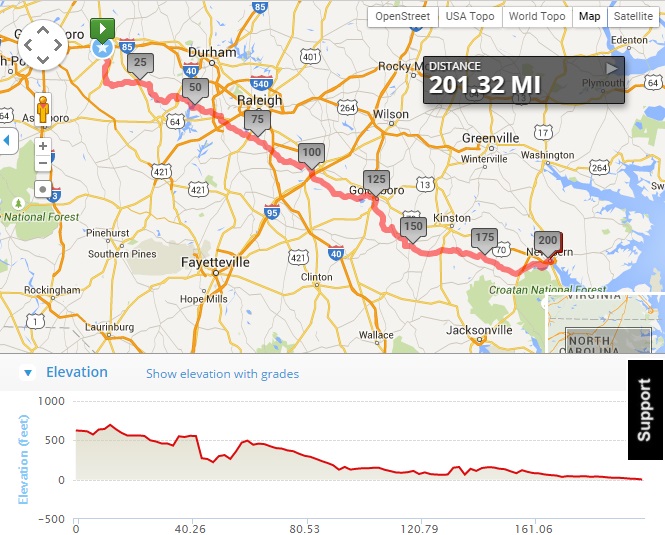
Have I confused tough and stupid once again?  Do I enjoy long sessions of mental and physical anguish?  Have I gone so far into an addiction that I no longer recognize normal?  These are all questions for a certified professional to answer.  Since I am not currently under the care of a psychiatrist, the answers are all irrelevant because, whether or not I'm sane, I have signed up for the 2015 Double Down to the Beach, a single day double century from Burlington, NC to New Bern, NC.  That's 200 miles folks....201.32 miles to be exact based on the proposed route.  To be fair, this is not uncharted territory for me as I have done a similar double century a couple years ago. Maybe that just makes me that much more crazy though.

Having done DD2tB in 2013, I have the advantage of knowing what parts of my training worked, and what parts didn't.  Essentially, what I have done this year is left alone what worked, and tweaked what didn't.  That makes perfect sense right?  Sure it does!  That should translate to a very similar ride this year without that bonk at 130 miles.  refer back to my opening questions for a second...........Of course, I won't leave things quite that simple.  Since I have become a much stronger and faster cyclist this year, I am planning on joining the "A Group" for this ride.  For those who might not be familiar with this terminology cycling groups by speed are typically divided into A, B, and C groups.  The C group has an average speed of 16+, the B group is 18+, and the A group is 20+ for this ride.  My average speed in 2013 was 18.1mph which was my fastest century to date.  This was largely due to the fact that it was my first endurance ride where I worked in a pace line.  I was impressed with my ability to keep up with this group, and really doubted that I could go much faster.  However, these days, my training centuries (solo rides) are well into 19+ mph range for an average speed and I am getting faster with each endurance ride.  So I figure, why not push the envelope and shoot for the speed demons on this ride?


At the finish line in 2013, "Believe, Achieve"
So there you have it, my goal is to complete a ride over 200 miles long at what will be faster than rides half of that distance.  Will I be able to do this?  I'm not sure, and won't be until June 13th.  I do know that I have really worked on conditioning my body for rides of this nature, and I've been able to do it with a good bit of base knowledge of how I adapt to the workload of a double century.  Like the awning said in Wilmington, "Believe, Achieve"...that has been my mantra on more than one occasion when looking at something seemingly unreachable.  That will continue as I embark on this second double century in a couple of weeks.


Training, what worked before should work now....

If it ain't broke, there should be no need to fix it, so a lot of my training has remained the same as before.  In 2013, I concentrated on getting a lot of saddle time early in the year, and then progressing to logging big miles on rides as the weather started to warm up.  Right before Double Down, I had ridden nearly 2,900 miles.  With two more weeks of training, I have clocked around 3,600 miles so far.  This is in addition to the 2,000 miles in the last few months of 2014.  Those miles are very well rounded miles as well.  There have been hours on the trainer doing all sorts of intervals, road rides with lots of climbing, all out time trial rides, and endurance rides at moderate paces and relatively quick paces.  That was the mix in 2013, and I carried that training plan through to this year.

The difference I've seen between the two years is my speeds have improved substantially.  All across the board, I have somehow manged to add approximately 2 mph to my averages.  My endurance pace has improved from the mid 17's to the mid 19's, my time trialing has improved from 19's to 21 mph on three occasions.  Even my climbs have improved with Caesar's Head going from 6 mph to 8 mph.  Just looking at those numbers, I can tell that my fitness level is quite a bit higher leading up to this year's Double Down.

As with any other long ride, you really should work up to the distance gradually.  In 2013, I had ridden a total of 11 100K routes, 2 full century routes, and 2 200K routes.  This year I have only done 10 100K routes, but I've completed 5 full century routes, and 2 additional 200K routes.  All of these have been faster than anything I did in 2013.


Cresting Caesar's Head at the 2015 Assault on the Carolinas
I pretty much followed the plan from 2013 with increasing frequency of centuries as the months progressed.  The idea here was to get my legs used to the distance, and make a century almost like a base mile ride.  Throwing a couple of 124 mile rides in takes me beyond that 100 threshold and lets me see how my body responds to the increased miles.  Keep in mind that these rides are all solo and I'm doing 100% of the work for the whole distance.  this was important in 2013 because I wasn't planning on doing a training double century at any time.  However, pulling the full workload over 124 miles does translate fairly well to sharing the workload over 200 miles.  Something I was seeing with these training centuries was that my averages were climbing even though I was feeling fatigued by the end of the ride.  In most cases, my speeds actually improved as the ride progressed.  The biggest exception to that observation came on my last training century on June 1st.

I had decided that I wanted to simulate fatigue in my legs and instead of starting out fresh which I always recommend for a century ride, I had ridden all but two days the week prior, and leading up to the century, I had ridden 27 miles, followed by 54 miles.  Effectively, this put me in a bad position as I was already feeling fatigued when I started the ride.  While my average speed dropped to 18.9, I considered this a very good ride because I was able to maintain around the 19 mph mark for the full 105 miles.  That's a pretty big deal to me, and a result in uncharted territory for me.  I'll be playing around more with this for my next event ride which is a three day stage ride with progressive mileages culminating in a full century on the last day.

Something else that worked for me in 2013 was spending a great deal of time on the stationary trainer in the off season.  This actually had two very specific benefits.  First of all, it allowed me to operate at a specific output for a predetermined amount of time.  There was no go until you get tired.  If the interval was 10 minutes, you went for 10 minutes.  If it was 30 minutes, that's how long you plugged along.  Related to this was the concept of active recovery.  I learned how to bring my heart rate back down and rest while still making headway. What this allowed me to be able to do was to stretch my breaks much further than I had been used to.  In 2013, I was able to ride 50 miles without stopping because of this technique.  This year, I repeated that, then made it 62 miles, and then just last month rode 70 miles without stopping for a break.  While I won't need that kind of endurance for Double Down, it's very nice to know that I can do it, and won't be limping in for the rest stops every 30-40 miles.


Tweaking, what didn't work before needs to be changed


In 2013, I had the legs, I had the heart.  What I didn't have was the proper fueling for a ride of this magnitude.  The preride eating I think worked just fine and I plan on duplicating that again this year.  However, my nutrition on the ride lacked a lot I think.  I was good for the first 135 miles or so, but then bad things started to happen to me.  I cramped, I couldn't eat, my legs were not as strong as they should have been...in short, I almost bonked.  This was my biggest downfall in 2013.  My diet was largely sugar based, and did not posses the proper range of nutrients.  I also wasn't consuming enough through the ride.  My staples were Power Bars, Honey Stingers, and granola bars.  I was using water and Gatorade to wash it all down with.  Had it not been for a sample of Hammer Perpetuem toward the end, I have my doubts that I would have actually finished.

This year I have reworked my diet on several different fronts.  First of all, I have eliminated the granola bars, and reduced my dependency on Power Bars as well.  The Honey Stinger cookies are gone too.  My core solid diet for long rides is now built around a waffle and Nutella sandwich which has all the ingredients an endurance cyclist needs with simple carbs, fat, and a little bit of protein.  It tastes really good too, and one sandwich is sufficient for a full century.  Of course, I will supplement that sandwich with Toni's homemade coconut macaroons which are loaded with carbs, and not a whole lot of sugar so there is no crash when the effects wear off.  Two of those are usually good for the first 50 miles or so, and then a couple for the last little bit will get me over the hump.  I keep a Power Bar in my jersey pocket still just in case I need that boost in energy.

As I learned in 2013, though, I don't function very well on solid food alone.  Something that I have been playing with on my more recent centuries is a liquid diet based on the Hammer Perpetuem.  I've actually seen very good results with this product and it has allowed me to go 70 miles straight with no solid food.  Essentially, it's a powder that is mixed in to a bottle of water and it includes plenty of carb based calories along with some fat as well.  It tastes a little funny, but for some reason on a bike, it just tastes right.  You mix it up based on your weight and the time you are planning on consuming it.  Since it does have a limited shelf life once mixed, which is truncated in the heat, I can only bring one bottle along for my self sustained centuries.  However, for Double Down, I'll be able to swap out for a fresh bottle every 30-40 miles which works out great.  Since it is largely water based, I will be getting some hydration from that, and will have an additional bottle of water with me for straight hydration purposes.

What I am hoping to achieve here is having a much lower dependence on solid foods which will only be consumed at the rest stops since I am just not coordinated enough to eat and ride at the same time.  I will be able to grab a bottle and drink a liquid diet while moving forward though.  That should keep my fuel stores in order for the long haul so I can maintain my energy level for the duration of the ride.  I'll get the solid foods for that boost every couple of hours.  When it comes to electrolytes, I will still have my Gatorade, but that will be used when the calories are needed.  To keep from bloating from the sugar, I will be using electrolyte tablets in my water bottles after the first rest stop.

While diet is the biggest thing I intend to work on for this year, I also have a better understanding of group riding than I did in 2013.  I'm by no means a master at it because I still don't do it often (enough).  However, I know how to avoid surging when I take the lead in the line, and I know that will be appreciated by the others in the pace line.  I had issues with that for most of the ride in 2013, and it did cause problems.  I think that once we get a pace established, I'll be able to maintain it without a problem.


What are my worries this year?

Well, my biggest worry in 2013 was whether or not I would actually complete the ride.  This year, I'm not so much worried about that, although it will always be a concern.  What I'm worried about is my choice to join in with the fast group.  This would be a truly stellar event if I were to finish it with an average around 20 mph!  It's possible, and I think I'm up for it.  The catches will be the weather which is forecasted to be kind of rainy off and on through the day.  This will slow me down, and I would assume everyone else.  It will also make riding in a pace line difficult due to the constant spray from the wheel in front of you.  That means more energy being expended while in the line.  If I can't hang with the fast guys, then I will be able to drop back into the B Group, but what happens if I make the decision too late and I've blown up by the time I get absorbed by the next group?  This is only an issue because I'm stubborn, and will stick with my chosen group until I just can't anymore, but by that time, I'm likely be be in pretty bad shape and not up to maintaining an 18+ pace anymore.  I'll just have to really pay attention to the signals my body is putting out I guess.

I have to admit it is nice not to have to worry about the bike like I did in 2013.  Back then, I was using a bike that was already a couple seasons old, and had been through quite a number of changes.  I remember my rear bottle cage mount broke, and I was having all sorts of difficulties with the Zipp wheels on my last bike right before Double Down.  This year, I am riding a basically new bike, but with close to 3000 miles on it already.  So far, everything seems to be working well and holding together.  This will allow me to worry about things that I can control, like my ability to hang with the A group.

The weather on the hand can't be controlled.  If you will remember, I started off the last Double Down in a steady rain that stuck with us for the first 30 miles.  The next 30 were wet roads.  This year, might be similar with rain on and off for the whole day.  On the lighter side though, the temperatures are looking to stay in the 70's and the wind should be coming from the Southwest.  That would make for a cross wind, and not a headwind as we make the final charge to the coast.  Not having a headwind would almost make it worth riding in the rain...almost.


Parting thoughts...

2013 was all about being able to say that "I did" rather than "I'm going to."  This year, I can't really spin it like that.  Having done it before, this ride is not there to prove anything at all.  I can't even say that if I stick with the A Group it will be all that important of a ride.  So, why am I doing this double century ride?  This one is just for me, to prove to myself that I still have it in me at 41 years old, and that I can do it better than when I was 39.  In just a couple of weeks I'll once again count myself among the ranks of the ultra endurance cyclists.  This will probably be my last year doing this ride though.  A century ride has now officially become, just another really long ride.  I am looking forward to seeing just how the 2015 Double Down to the Beach turns out.  With any luck, my new diet plan, and proven training plan will do what planned and I'll make short work of this epic ride.

Thursday, May 28, 2015

The Evolution of a Cyclist


If you have been following this blog for a while, I'm sure you have noticed this picture in the upper right column.  It's one of those graphics I found funny a long time ago and added here because I was essentially documenting my own evolution.  You may recall reading a post where I detailed many of the changes that my first bike went though back in 2012.  When I wrote that piece, I had only been a cyclist for about a year.  I had learned a lot about the equipment needed, but honestly had just started to understand what I needed as a developing cyclist.  Looking back, I can tell that as with so many other riders, I was an equipment junkie.  I liked getting gadgets, and dressing the bike up.  There is nothing at all wrong with that, but my own performance on that bike was a secondary concern all too often.

Since November, 2012, I have learned a lot about myself as a cyclist.  I have grown, and developed into something that I would have never considered possible.  It's no longer about the bike (although, I still get a lot of joy dressing it up), it's about the engine that motivates the bike.  This post will hit the highlights of that very important evolution, the evolution of the cyclist.


2011


It has been said that it takes three years for a cyclist to really come into their own.  I am pretty sure that I subscribe to that concept, as I've seen the theory play out in my own riding.  However, that three year tenure had to start somewhere.  For me, it was in June, 2011, that the seeds for cycling were planted.  I needed to find a way to help teach my seven year old how to ride without training wheels.  Since I was not really able to run after her so she could keep pedaling, I decided to get a bike to ride with her.  Not knowing anything at all about cycling, I went to Wal Mart and got the only bike that would fit me.  I was the proud owner of a 29" mountain bike.  I proved that I had not forgotten how to ride a bike (just like the saying goes), and I went out several times a week with Sierra to help her get accustomed to riding.

As I showed her how to get started, turn, and stop, I found that I was starting to feel like a little kid again.  I was looking forward to getting on a bike after work and playing for a bit.  The basic handling drills were helping me out as I started to remember how a bicycle handled.  Hey, it had been some 20 years since I had last ridden one.  I thought I was doing good not to fall over.  Circles around buildings turned into rides around the neighborhood.  Eventually, I was wanting more than what Sierra was interested in doing, so after I spent some time with her, I would set out on my own to explore other neighborhoods.  I even found that some of the construction sites in a neighboring community made for some really fun off road adventures.


I enjoyed playing in the dirt, but somehow felt a little unstable when I was on the rutted ground.  I would experiment with different speeds over different terrain and found a good bit of excitement in these rides.  However, after some time, I started to feel a little silly riding in the dirt.  I felt that it was time to try some road riding again.  When I was about 13, I got my first 10 speed bike, and rode all over my Grandfather's neighborhood and I wanted to experience that again.  For that, I was going to have to venture onto some of the secondary roads beyond the neighborhoods I had been riding in.

We live off of a pretty major road, but there is a secondary street that runs out of the neighborhood into Walkertown which looked like my best bet for a road ride.  One evening, I filled a water bottle up and started off down the street.  It was slow going, and I felt very exposed out there on the street with traffic whizzing by at near 50 mph.  There were hills I had to climb (well, they felt like hills), and what seemed like many miles to ride before I got to my destination.  There was a school about 2 miles down the road where I had planned to turn around at.  I'm not sure how long it took me to get there, but I recall it being a significant amount of time.  Once I arrived, I remember having to get off of the bike and sit down on a bench to drink my water.  I used that time to call Toni and let her know of my accomplishment and the fact that I had to go back that same distance to get home.  That seemed like a such a long way to go, and I was already tired.

I made it back and didn't pass out.  Over the next month or so, I added to that mileage and was riding 10 miles routinely, several times a week.  It would take me about an hour to do, but I found that I was having a lot of fun doing it.  I was starting to explore different roads, and was even starting to climb some hills that I had looked at and thought "OH HELL NO" just weeks before.  It wasn't long before I was riding into Kernersville on the weekends, and even did a 32 mile ride into Greensboro.


Wedding day, 01-11-2011
One thing that I really hadn't considered was the potential weight loss with riding a bike.  I had not started this with any intention of losing weight, but I was noticing that my clothes were starting to get looser, and I was feeling better.  I'm not sure exactly what was going on with the weight, but I know that the last time I had weighed myself at the beginning of the year I was at 238lbs.  This had come as a complete shock to me when I weighed in.  I knew I was a little over the 190lbs mark I had been the last time I weighed myself, but this was well beyond what I would have thought.  When I saw that number, I tried to cut back on some of the junk food I had been eating, but never really saw much difference.  After riding a bike for the better part of two months I was finally starting to see a difference.  I don't know what the numbers showed because we didn't have a scale at the time, but I was feeling much better, and I liked that feeling!

By the end of July, I had pretty much decided that I was going to really give cycling a good try.  I was loving everything about it.  I had also left the dirt trails behind and settled into being a roadie.  Being a pavement pounder was not easy on a heavy mountain bike, and the general quality of the Wal Mart bike was lacking for the use I was throwing at it.  The decision was made to upgrade to a new road specific bike.  On my first ride, I immediately reaped the benefits of the lighter frame, and more speed oriented design.  I managed to go 50 miles my first time out, beating my best distance by 18 miles, and doing it at an average speed of 16 mph as opposed to 13 with the mountain bike.  I was sold!


2012

2012, was my first full year as a cyclist.  It was full of wonder and excitement.  It was also full of hard lessons that had to be learned.  If there was a basic mistake to be made, I think I made it.  It was months and months, maybe even a full year before I figured out what the little ring was for on the crank.  I had strong legs, and I wanted to push big gears.  All I did was eventually blow my knee out, kill a cassette prematurely and wear out a chain in under 900 miles.  Sometime at the end of the year, I finally allowed myself to use the little ring for warming up and for climbing.  It did make everything much easier, and strangely enough, my average speeds started to climb into the 17's.

One of the biggest areas where I faltered as a newbie cyclist was in my pedal choice.  As many others do, I had a fear of falling because my feet were trapped in the pedals so I resisted making the move to clipless pedals until many thousands of miles had passed under my bike.  At first, I wasn't really sure that I had made the right decision to move to clipless, but in time I started to develop different muscle groups in my legs which really took a lot of strain off of my overworked quads.  This allowed for better climbing, more efficiency for longer routes, and after some time, my speed really did improve.  Yes, I fell...twice as a matter of fact due to the pedals.  It took a few months before that happened after making the switch, and I can only assume it was when I started to get comfortable with them and stopped thinking about them as much.  At any rate, I was one of the statistics now.  When you go clipless, it's a matter of when, not if, when it comes to falling.


The addition of the new pedals brought to light another problem that I had been ignorant to until my feet were planted on the pedals.  My fit was way off, and I was now developing some pretty significant knee problems.  It was time to get a professional fit to establish a proper position in the saddle.  In short order, my knee got better and I found a much higher level of comfort on the bike.  All of a sudden, I was starting to feel like a "proper cyclist."  I had the funny clip clop shoes, the little pedals, I was concerned with the degree of my knee bend, as well as endurance vs performance rider positioning.

An interesting aside from my bike fit was a bit of extra knowledge that I picked up while talking to the fitter.  He had been instrumental in getting me to go into the little ring for warm ups and significant climbs, but now he was taking it a little bit further.  Since I was using a Garmin computer with a host of sensors, I knew that my cadence had been averaging about 60 or so rpms.  As part of the fit, I had to share that bit of information.  I had heard that proper cadence was usually around the 90 rpm mark many times, but when I had tried it, I felt like I was going to spin right off of the bike.  However, since I was having knee issues prior to the fit, my cadence was really brought under scrutiny.  Essentially, I was putting a lot of stress on my muscles and not relying on my cardio system to motivate me down the road.

I was under strict orders to increase my cadence to take some of the stress off of my legs and knees.  Despite feeling like I was going to spin the pedals straight off of the crank, I worked on this for the remainder of 2012.  I got into the 70's really quick, and then managed to average in the low 80's by the close of the year.  My speeds were slowing it seemed, but my legs were feeling better overall, and my endurance was starting to improve.  Slowly, I was starting to get my original form back.  The awkwardness started to dissipate and my speed and power started to return.

One other benefit from my fit was learning the importance of stretching after my rides as part of recovery.  I had always read that your muscles needed protein to help rebuild after a hard ride.  This was only part of the formula though.  To help the muscles repair and speed recovery though, stretching needs to be done after a ride as well.  It's amazing how tight your muscles get after several hours of riding.  You don't really notice it, but when you are trying to stretch, you can really feel it.  By stretching you actually seem to calm the muscles down, and usually avoid major stiffness after a workout.  With the protein, and lots of water added to the stretching, you are typically ready to ride the next day.  This was a change from before when I would have to rest a day after every ride, or risk feeling very bad on the bike.


Probably the best bit of knowledge that I took from 2012 was pacing myself, or as a friend would say, "riding your ride."  I found that despite how far I was riding, or the terrain, I would ride the same way.  It wouldn't be flat out, but I was always looking to squeak out just a bit more speed.  This is fine for a short ride, but looking back at my splits, I could see that my averages would drop through the course of a ride.  By the time I got finished, I would be nearly limping in with nothing left in the tank.  It wasn't that much of a problem until I rode on the Blue Ridge Parkway for the first time.  For the first time on this ride, I found out what it meant to totally burn up midway through.  I had never done hills like this before, and I was having fun going up and down.  The only problem was I was burning up every bit of my energy and left none for the big climb of the day which I had a terrible time completing.  The return leg was a constant struggle and I was seriously concerned about whether or not I would make it.

A few months would pass before I had the opportunity to tackle the Parkway again.  In October, I went back with a couple of friends and put some things to the test to see if I had actually learned from my earlier mistakes.  The theme for this ride was to ride my ride and control my pace.  I saved my energy for the mountains, and didn't stress myself on the easier sections.  Sure, my speed was well below what I wanted to see, but I was climbing bigger hills than before with none of the pain from last time.  I had proven to myself that picking the proper pace works wonders, not only for climbing, but also for endurance rides.  This single epiphany prompted two of my bigger goals for the following year.  The first was a 65 mile ride in NC and SC mountains with a category 1 climb, and the second was a single day double century ride to the coast of NC.

2013

This was the first year I considered myself a "serious cyclist."  Now by serious, I don't mean one that rides for long distances, or is faster than a regular cyclist.  What I mean by this is I was looking at riding much more scientifically than I had been.  I had a good idea how to ride, and I knew a good many things that I should be doing, I was even incorporating most of them on the majority of my rides.  What separated 2013 from the previous years was I set out at the beginning of the year with three major goals.  Each of these goals would require work and training to accomplish.  This was going to be a year of training, not just riding...and trust me, there is a difference!

My three goals were simply to ride a 50 mile route with an average speed of 20+mph, Complete the Assault on the Carolinas, as well as complete Double Down to the Beach.  Honestly, I thought that the first goal was going to be the easiest to achieve.  At the close of 2012 I was averaging around 19mph on a 50 mile route so I was very close.  Well, my assumption was very wrong.  There was not a single time in 2013 when I achieved that goal.  I just couldn't make it happen no matter how hard I tried.  That was my only failure in that year though.


My next goal was to complete the Assault on the Carolinas 100K route.  It was not the distance I was having to train for, but rather the arduous climb up Caesar's Head.  This was a seven mile long, 2000 ft climb...otherwise known as a category 1 climb.  Since it was in April, I would not have much good weather outside leading up to the event.  That forced me to embrace the stationary trainer.  I was fortunate that Toni had surprised me with one of these little satanic devices in the closing months of the previous year.  It was not long before I was doing interval workouts while it was snowing outside, or very cold, or wet...or just not fit for cycling.  These workouts were not fun, but I was feeling improvement as the weeks went by so I continued on with it.  By late March, I was getting some road time back and I was actually seeing improvements in both my speed and endurance from the previous fall.  I actually had not only maintained my fitness from the previous season, I had built on it in several ways.  This marked the first "training" that I had done on a bike.  I was no longer riding, I was looking for specific performance gains.

Thanks to my work on the trainer and a short amount of time on the road, I was able to complete the Assault on the Carolinas and prove to myself that I could actually climb a category 1 climb!  This was incredible considering how poorly I had done on my first ride on the Blue Ridge Parkway not even a year before.  I was well on my way to improving as a cyclist and I was gaining confidence in my personal training programs.


My last major goal for 2013 was to complete a double century ride known as Double Down to the Beach.  While I had completed around ten century rides since I started riding, a 200 mile ride was a huge step for me.  It was so much more than just conditioning on the bike.  I had to learn my body all over again and figure out just how to fuel it for a ride of this magnitude.  I experimented, read many suggestions, and fine tuned what worked for me.  I was learning how to be an ultra endurance rider.  I wish I could say that all my preparation for this event worked out flawlessly, but I can't.  I found out that I didn't quite know myself as well as I thought, and that knowledge kicked in around 135 miles.  I finished, and I finished very strong, but there was about 20 miles or so when I was really worried that I would not be finishing.

Probably the biggest thing that I took away from this ride had nothing to do with riding a bike, or how to fuel myself for an ultra endurance event.  The most important thing that I took from this ride was when my body feels like it has to quit, and I don't think I can muster any more effort, my desire to finish what I've started will take over and pull me though.  Obviously, I had the physical ability to complete this ride, but I learned that with cycling, among other things in life, it's mostly mental.  I learned that I can quiet the negative voices in my head, and pay more attention to the positive ones...those are the ones that will get me through the rough times.  


As the year drew to a close, I made another trip to the mountains of NC, and I made one last century for the year.  Neither of these rides I would have been able to complete at the same point in the previous year.  With over 7000 feet of climbing over 65 miles, I felt like I was in my element in the mountains for the first time.  It was a smooth ride and I actually enjoyed the straining as I crested each climb.  The Carolina Century, while just another century (11 for the year), was probably the most miserable ride I had taken.  I would venture that 80% of the ride was in the rain, some of that was heavy downpours.  I was cold and wet because I didn't dress appropriately.  Even though it was miserable, I can't help but look back and see that I was conducting myself as a "real cyclist."  Yes, I was cold, yes, I was wet, but I did ride the route and make the full 100 despite all of the hardships.  You see, bike rides can't all be sun and fun.  It's the hard ones that define who you are, and I felt rather defined after this ride.

By the end of 2013, I was really feeling like a cyclist.  A friend of mine told me that he had always heard that it was the 3rd year in the saddle when you really come into your own as a cyclist.  Doing the math (carry the 1, thumb, pointer, middle finger), 2014 was set to by my year!  I should have been excited, and I was, but I was also burned out, and I had no more big goals ahead of me.  Did this mean that I would stagnate, and not live up to the third year charm?  I actually started putting a lot of thought into that, and was thinking about it more than normal on a early November ride.

It was windy, and I was really starting to ask myself why I was putting myself through this physical exertion over and over.  What was I training for, why was I riding?  I told myself that I was riding to remain fit, and I was very happy at around 180lbs which was some 68lbs lighter than I was before I started cycling.  Even that wasn't much of a motivator for me though.  I wasn't sure how my cycling would progress into 2014, but by the end of the ride I had my answer.  It came in the form of a gust of wind from behind a U Haul truck.


I had ridden for over 12,000 miles at this point in my cycling tenure and had never had a major incident.  I was very lucky, but on November 3rd, that luck changed.  As the U Haul passed me, I got pushed over to the edge of the road and as it cleared, I started to move back to a more comfortable distance from the edge.  However, once the box truck stopped blocking the wind, it caught me just as I was starting to move to the left.  The bike shifted to the right just a few inches, but enough so that the front wheel left the asphalt.  Since I was already in the process of moving to the left, I didn't have time to correct and stay off the road, but found the bike trying to hop back on the pavement.  This is what causes cars to flip when they run off the road, and essentially that was what happened to my bike.  The wheels came out from under me and down I went.  My left side was covered in road rash, but I had nothing major as far as injuries.  I was able to limp the bike back home as well.  From this, I figured that my evolution as a cyclist was finished.  I had accomplished all that I set out to accomplish with the exception of the 20mph average.  I was busted, the bike was busted, it was time to hang up the helmet and quit while I was ahead.

2014


Yes, I realize that I just said that my evolution was complete.  I guess I lied a little bit to myself.  Between November, 2013 and July, 2014 I had steadily lost my fitness and started putting weight back on.  I found out that getting old sucks (previous link) and I didn't like it.  I also did a lot of evaluating of my life and why I was going through some of the issues that I had been dealing with recently.  What I ultimately determined was that I was far from done with cycling.  I actually needed it in my life and was really missing it much more than I could have ever imagined.  Emotionally, I think that this was probably the pinnacle of my evolution.  I was no longer wanting to ride for distance, or for accomplishments.  I was wanting to ride for myself, and my own well being.  I just hoped that I wouldn't have to start from ground zero again.


On my first ride after getting my new bike, I found that I had not lost everything I had worked to get, but I had lost a significant portion and I had a lot of work to do in order to get back to where I once was.  On the brighter side, even struggling with a maiden 50 mile ride, I was having a blast and truly enjoying being back in the saddle again.  I was far from the svelte rider I once was now topping out at 205lbs, but I knew that I would be able to whittle that down in time as I had done once before.

I started work on finding my form once again.  After being sedentary for about 10 months, I was willing and ready to spend some time on the bike.  I was starting to find my stride again and started getting optimistic about regaining much of my previous performance in short order.  Then it happened...another flippin' crash!  This time, it wasn't the wind that knocked me down, it was the side of a Dodge that turned in front of me that I hit.  This really should have been the end of my cycling as I'm pretty sure somebody was trying to tell me something.  However, after so much soul searching about why I needed to ride, I actually just viewed this as a minor hiccup in my return.  I was very fortunate that the driver's insurance really came through and made me whole again.  I was only down and out a couple of weeks before I had my crashed bike back and mounted to the trainer once again.

2015


As the year opened up, I was firmly committed to riding the indoor trainer.  Maybe I should have been committed because it is totally absurd to spend 6 out of every 7 days on a stationary bike grunting and sweating like I was doing.  I was starting to see results though.  My legs were feeling much more like what I remembered, and even better, my numbers were starting to mimic those that I had been producing at the peak of my previous cycling career.  I was very excited that I might actually see a return to my former performance before my estimate of a year was up.  My interval sessions were showing higher speeds, and more power with each passing week.  As I was looking at the numbers, and figuring out the rough conversion from what I had seen before, I was starting to expect that I could ride on the road at a relatively comfortable 20mph pace.  Wait a minute, what's that?  The elusive barrier of 20mph?!?!?  If you will recall, that was the one goal that I had to abandon in 2013 because I could just not break that wall.  Here I was still in the off season development stage looking at a very real possibility that I could finally see that goal happen.  I think that motivated me to push even harder, and harder I pushed.

The more I saw performance increases, the more I started to think about setting goals for myself once again.  When I got back into cycling, it wasn't going to be about the same types of goals that I had once chased after.  I was going to be happy just being able to ride at a respectable pace.  But this is where my competitive nature comes in, and I was seeing that I would not only match that fitness level, but surpass it very soon.  I wanted to put my body to the test and see just what I was capable of doing.

It seemed only logical that my first goal would be to complete a 50 mile ride with an average speed of 20+mph.  Yeah, I've tried that before only to be disappointed, but I had a feeling that I would crack that barrier at some point in the season.  My second goal to make a repeat appearance at the Assault on the Carolinas and climb Caesar's Head one more time.  I would follow that up with another go at a double century with the Double Down crew.  You may be wondering why I chose to do these two repeat rides since I have already conquered both of them previously.  The answer is actually rather simple.  I wanted to be able to make direct comparisons to known quantities to gauge exactly where I am in my training.  Beyond those two events, I have chosen to ride in a multi day event that is similar to my previous Tour to Tanglewood rides, but has an extra day, and about 90 more miles to it.  This is "A Ride to Remember" and I'm expecting it to tax my body due to the increasing distances each day (67, 87, 100 miles) and the fact that it is in the middle of July in South Carolina.  This is the unknown of the year, and what might actually prove to be the most difficult for me.

As of the writing of this entry, I have made some headway on my goals.  First of all, I cracked the 20mph barrier on Jan 1st.  I clocked a 50 mile ride at 20 even!  I followed that up with a 64 mile ride in April at the same average.  Just to be sure I wasn't seeing things, I did a repeat performance in May with a 71 mile ride with an average speed of 20.6!!!!  I think we can safely say that I have finally achieved my long standing goal of a 20mph avg speed ride.  While not a huge deal overall, this was a huge boost to my confidence on the bike.  I really felt like I was riding at a different level than before, and it came in what could only be described as my third year on the bike.  There might just be something to that urban legend.


In April, I had my second meeting with Caesar's Head.  It was all too familiar for me, but I could tell quite a few differences.  The final numbers actually look very similar to each other, but I was able to look deeper into the ride when I was examining it.  The first 40 miles of the ride this year were actually harder due to so many cyclists on the road.  It was darn near impossible to get around them to find a patch of open road to "ride my ride."  That kept my averages down lower than 2013's averages.  That didn't really bother me since my main purpose for doing this ride was the climbs.  The first big climb of the day went very well.  So well, in fact, that I found myself actually passing other cyclists on the road and being able to accelerate at will.  I wasn't expecting that, but I was sure happy to see it.  By the time I got to the cat 1 climb, I found that I was able to climb it a touch faster than before, and without feeling like I was going to die.  I felt so good by the top of the climb I didn't even take advantage of the rest stop, and just continued on to the finish.  Even though my numbers looked very similar, the way that I felt on this ride was worlds apart from my 2013 experience.  In short, this ride was not that taxing on me.  No matter how you look at it, I came to the party in better shape in 2015 than I did in 2013, and I rode much smarter to boot.


April, 2015
I have mentioned my weight a few times in this entry, but don't confuse that as being the evolution I have been talking about.  Weight is more a piece of the puzzle when it comes to cycling than a primary focus.  It stands to reason that the more you weigh, the harder you have to work to maintain a given speed, and the more power is needed to climb hills.  When I started riding in 2011, I was around 238lbs.  When I stopped riding in 2013, I was around 187lbs, and had been as low as 174lbs a few months before.  By September of 2014, I was back up to 205lbs.  When I rode in the AOTC I was around 168lbs which was the lowest I had seen in 16 years.  In fact, I had done some research of my "ideal" cycling weight in 2013 and found it to be 167lbs.  Granted this was an estimate and far from exact I'm sure.  However, I had tried to reach that weight before and never could get there.  Now, without really focusing on that number I had managed to basically get there.  Pretty cool I thought.  Here we are at the end of May and I am staying consistently at 165-168lbs and I have to admit, it does make riding much easier.  This was never an official goal, I had just wanted to get healthy.  I feel better than I've ever felt before, and I feel better on the bike than I have ever felt before.

Here we are at the close of May, and I actually feel like my evolution has been completed.  There will still be improvements along the way, but for the first time, I feel like an honest to goodness cyclist.  Also, for the first time, I think that I'm becoming an all around cyclist.  In the past, I had only been about endurance rides.  I was unable to sprint, I was marginally fast, but in the eternal "B group" it would seem.  When it came to climbs, I could do them, but they hurt me, and I didn't like them.  Here we are in cyclist 2.0 territory, and I still have my endurance legs (4 full century rides, 2 additional 200K rides so far).  I've also added a good bit of speed to my repertoire making my official training pace 20mph.  Heck, even my centuries are in the 19's now!  When it comes to climbing, I have almost gotten to the point that I enjoy them.  The short ones, I try to sprint up in a big gear just for fun.  The longer ones, I will take at a more comfortable pace, but I still push myself to get better times in the climbs. Thanks to all the time on the trainer, I have learned about active recovery which allows me to recover after a strenuous effort while still riding and making good time.  This allows me to attack the climbs, recover, and then hammer the flats all without taking a break.

There are now 16 days left before I tackle Double Down to the Beach once again.  Of course, I can't look into the future to see how that will go, but I know that I have really ramped up my training compared to 2013 and based on everything that I am seeing so far, I fully expect to turn in much better numbers this year, and have a stronger second half.  My centuries are faster, have less breaks, and are more consistent across the splits now than ever before.  A good many of my centuries and 200K's have even shown noticeable increases in pace with each passing 25 mile block.  I expect this training to transfer over to my three day ride as well.  I'll have to work on a few things before so that I don't burn out before starting the century, but I have the basic fitness and endurance to get me through this ride as well.


So, there you have it...from June, 2011, to May, 2015, my evolution as a cyclist.  When you take out that 10 month break, I am in my third year of riding.  At 41 years old, I can't imagine how I am able to do the things that I do on a bike.  Had I been riding all my life, that would make sense, but I haven't.  What I am accomplishing has taken place in just three years.  I think that I was meant to be on a bike, and when I am on a bike, I feel more like "me".